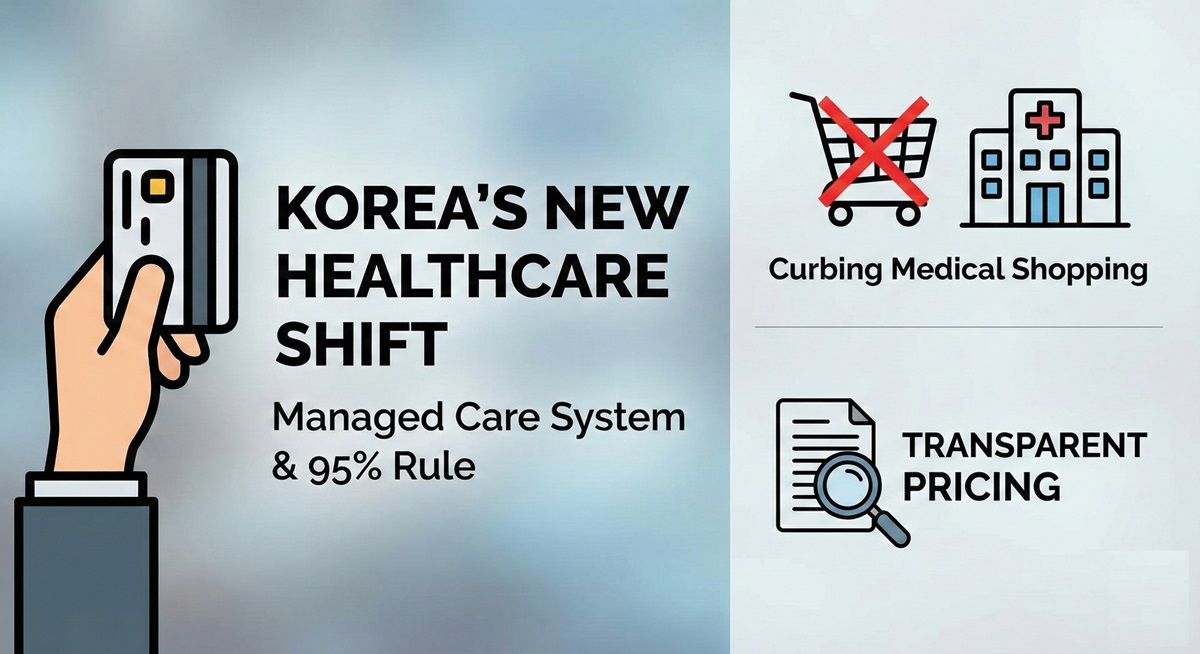
Putting the Brakes on Excessive “Non-Covered” Medical Shopping… 95% Out-of-Pocket Implemented(managed care system) Source: Yakup News
Hello! I have a history of back issues that eventually led to surgery, so I know this situation well. Before my surgery, almost every hospital visit came with a strong recommendation for manual therapy (physical therapy), and I actually received it quite often. I’m sure most of you have experienced this casually suggested treatment at least once.
However, starting in February 2026, this common hospital scene is set to change drastically. The government is putting the brakes on the snowballing trend of excessive “non-covered” medical shopping by fully implementing an unprecedented policy with a 95% out-of-pocket rate.
You might be wondering, “If the patient has to pay 95% out of pocket, isn’t there essentially no benefit?” You are right. The immediate financial burden you feel might not change much right now. However, beneath the surface of this policy lies more than just price control; there are four intricate gears working together to fundamentally transform the constitution of South Korea’s healthcare ecosystem. Let’s walk through why this policy was necessary and how it works, relating it to our everyday reality.
The managed care system: Framing Regulation as Protection
What if the government simply announced it was forcing hospitals to lower the price of manual therapy? It would have likely sparked fierce backlash from the medical community and confused patients who might feel their right to quality treatment was being infringed upon. What stands out here is the brilliant strategy of “framing.” By pulling previously non-covered items into the boundaries of national health insurance, they branded it under a new managed care system.
Up until now, relying heavily on private indemnity insurance (Silbi), we have consumed non-covered treatments without much second thought, letting hospitals practically dictate the prices. However, by integrating these into the national coverage system, the government has established a powerful justification: “The state will directly manage abnormal price bubbles to protect the public.” Even though the immediate out-of-pocket cost is a staggering 95%, establishing clear baselines in what used to be a lawless market is an excellent shift in framing that offers psychological reassurance.
The managed care system: Evolution of Governance and Management
Historically, the non-covered medical market was a thoroughly neglected free market. It operated on a deformed structure where hospitals recommended expensive treatments, patients agreed, and private insurance companies footed the bill. In this process, the role of the state as a control tower was completely absent. Essentially, “governance” was nonexistent. This systemic reform marks the moment the state finally stepped into the empty management room, wearing the supervisor’s armband.
- Transparency in Price and Frequency: Now, items like manual therapy or multifocal lenses for cataracts are designated under the managed care system, subjecting them to controls such as government-set standard prices and annual maximum coverage limits.
- Blocking Over-treatment at the Source: By establishing clear, medically necessary application criteria, a new form of “regulatory governance” is established. This prevents insurance leakage and reduces the burden of premium hikes for well-intentioned policyholders.
The managed care system: Hitting the Brakes on Old Habits
People do not easily change the ways they have grown accustomed to. The patient’s attitude of, “Just give me the best treatments since I can claim it on my private insurance anyway,” paired with the hospital’s sales tactics to maximize profits off this mindset, had fallen into a decades-old, entrenched practice known as “path dependence.” To break this powerful inertia, a mild recommendation would not suffice; strong shock therapy was needed. The number “95% out-of-pocket” acts precisely as that brake.
Now, before paying their medical bills, patients will have to ask themselves: “Do I really need this treatment? How much of this will my specific tier of private insurance actually cover?” By making patients directly verify and feel the financial weight of the amount printed on their receipts, the managed care system serves as a highly sophisticated psychological mechanism that encourages them to break free from the cycle of unconscious medical shopping.
The managed care system: Restoring Homeostasis in the Healthcare Ecosystem
Finally, let’s imagine our healthcare framework as one giant living organism. Living organisms possess a survival instinct called “homeostasis”—the ability to maintain internal balance against external threats.
Over the past few years, the abnormally inflated non-covered market acted like a massive tumor, sapping nutrients from our medical ecosystem. As medical professionals flocked to highly profitable beauty and pain management clinics, essential medical fields directly linked to saving lives—such as pediatrics, obstetrics, and emergency surgery—suffered from severe staffing shortages.
This new measure is a powerful immune response created by an ailing ecosystem to heal itself. By strictly managing non-covered items that previously guaranteed excessive profits and raising the application standards, it aims to naturally restore homeostasis. This process redirects medical resources and finances back to the essential healthcare sectors vital for our survival.
Conclusion: Becoming a Proactive Consumer
In summary, the government’s 95% out-of-pocket card is not a one-dimensional measure aimed simply at increasing the financial burden on patients or reducing losses for specific groups. Rather, it appears to be a macroeconomic structural improvement. It smoothly shifts public perception through framing, introduces state intervention to establish clear rules in a neglected market, shatters entrenched over-treatment practices, and strives to restore balance to a collapsing essential healthcare ecosystem.
For a long time, we have been too accustomed to reckless medical shopping, sometimes treating it almost like a trend. However, the era of blindly relying on expensive, non-covered treatments has come to an end. What we need now is not to blame the system’s changes, but to adopt an attitude of becoming rational and proactive healthcare consumers by accurately understanding the core intent of the policy. I look forward to the settlement of a mature medical culture where we pause to consider what treatment we truly need before visiting the hospital and meticulously check the items on our receipts.